
Call: 01234 261385

Product Marketing That Works in 2025: Turning Principles into Pipeline in a Cautious UK Economy

If you’re launching or scaling a product in the UK right now, you’re doing so in a market where consumers are more selective, promotions matter, and borrowing costs have just edged lower but remain material. That makes disciplined product marketing not just important, but essential. In this article, we map four core principles—target audience, value proposition, pricing strategy, and marketing channels—to practical actions you can take today. We also ground every decision in the latest UK macro and consumer backdrop so you can align budget, messaging, and channel mix with how people are actually spending.
UK consumer backdrop: what’s shaping demand right now
- Inflation and prices: UK CPI inflation rose 3.6% year over year in June 2025 (up from 3.4% in May). On a monthly basis, CPI increased by 0.3%. Transport, especially motor fuels, was the largest upward contributor, while housing-related categories partially offset the rise on the CPIH measure. This means price pressures persist in everyday categories that consumers notice, sustaining price sensitivity in discretionary spending [Office for National Statistics].
- Interest rates and financing costs: The Bank of England cut Bank Rate by 0.25 percentage points to 4% at its meeting ending 6 August 2025 (published 7 August; vote 5–4). The Committee stressed policy is “not on a pre‑set path,” and future moves will depend on how disinflationary pressures evolve. For households and businesses, this incrementally eases financing costs but keeps money far from “cheap,” reinforcing careful purchase decisions and ROI scrutiny [Bank of England].
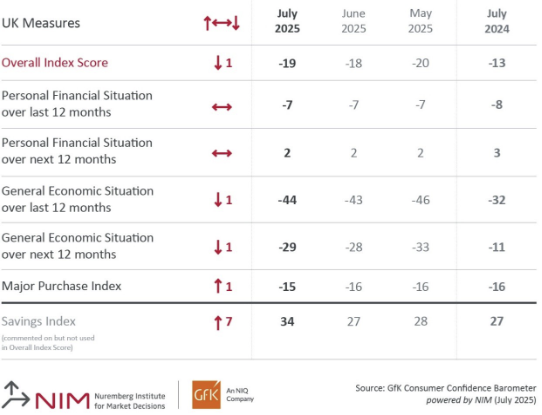
- Consumer confidence and saving behaviour: GfK’s Consumer Confidence Index slipped to −19 in July 2025, reflecting caution. Notably, the Savings Index surged to +34—the highest since November 2007—signalling households with means are building buffers instead of spending freely. Expect uneven demand and a flight to value and trust [NielsenIQ/GfK].
- Retail dynamics: Retail sales volumes rebounded 0.9% in June after a steep −2.8% in May (revised). Online/non‑store volumes rose 1.7% in June, reaching the highest level since February 2022. Weather and promotions were cited as contributors—another proof point that tactical value cues move demand even when confidence is weak [Office for National Statistics].
- Labour market and wages: The unemployment rate reached 4.7% in April–June 2025, and the employment rate stood at 75.3%. PAYE RTI suggests payrolled employees have declined across most of the past year. Still, nominal regular pay grew 5.0% in April–June, translating into positive real pay growth of 1.5% when deflated by CPI—providing some support for spending, albeit selectively [Office for National Statistics] [Office for National Statistics].
- Growth backdrop: GDP grew 0.3% quarter‑on‑quarter in Q2 2025. Services expanded 0.4% and construction 1.2%, while production fell 0.3%. The mix favours digital, information/communication, and health-related services, with wholesale/retail acting as a drag—consistent with selective consumers and intense competition for share [Office for National Statistics].
Macro snapshot (UK, latest available)
| Indicator | Latest | Period | What it implies |
|---|---|---|---|
| CPI inflation (YoY) | 3.6% | Jun 2025 | Persistent price pressure keeps consumers value‑conscious [Office for National Statistics] |
| Bank Rate | 4.0% | 7 Aug 2025 | Financing costs ease slightly; ROI scrutiny remains high [Bank of England] |
| Consumer Confidence (GfK) | −19 | Jul 2025 | Cautious sentiment; higher propensity to save [NielsenIQ/GfK] |
| Retail sales (MoM, volumes) | +0.9% | Jun 2025 | Promotions and online drive selective rebounds [Office for National Statistics] |
| Unemployment rate | 4.7% | Apr–Jun 2025 | Labour market softer; careful big‑ticket spending [Office for National Statistics] |
| Regular pay growth (nominal) | 5.0% | Apr–Jun 2025 | Real pay is modestly positive; value still decisive [Office for National Statistics] |
| GDP growth (q/q) | 0.3% | Q2 2025 | Slow growth; services-led, retail mixed [Office for National Statistics] |

Four product marketing principles, applied to today’s market
1) Target audience: narrow, evidence-led, and segment by value
Precision beats reach when confidence is weak and channels are fragmented. Start with clear segments by need state and value—what job the customer is hiring your product to do, under what constraints (budget, urgency, compliance, switching cost), and on which channels they actually engage. Use behavioural and financial signals to prioritise: for example, a segment that buys when promotions run and prefers online may be more responsive right now, consistent with June’s non‑store volumes rising 1.7% to the highest since February 2022. Invest in journeys and offers that meet that behaviour, like timed discounts, frictionless checkout, and clear delivery SLAs, rather than blanket spend across less responsive cohorts [Office for National Statistics].
Qualify segments by what the economy permits. With real wages only modestly ahead of inflation and confidence at −19, consumers are rewarding brands that reduce perceived risk and maximise value. Prioritise use cases with fast time-to-value and low switching frictions; show proof quickly; and make renewals and add‑ons easy. Where borrowing costs matter (subscriptions with financing, B2B SaaS), note that Bank Rate at 4% still enforces ROI hurdles—your segment prioritisation should map to hard outcomes your buyers can justify internally [NielsenIQ/GfK] [Bank of England].
2) Value proposition: lead with outcomes, de‑risk the choice, prove it fast
A compelling proposition answers “why this, why now, why you” in the first 5–7 seconds. In markets where price sensitivity persists, the most effective value propositions:
- Tie to measurable outcomes, not features. For instance, “Reduce fulfilment cost per order by 12% in 60 days” beats “AI‑powered logistics.”
- Reduce perceived risk. Offer trials, pilots, or phased roll‑outs that mitigate switching risk and align with cautious sentiment and rising savings buffers.
- Provide social proof relevant to the segment. Case studies that match industry, company size, and use case overcome status‑quo bias—vital when retail and wholesale sectors are mixed and budget holders face scrutiny [Office for National Statistics].
- Make value tangible immediately. Pair time‑boxed promos with clear economic logic—promotions are working at the basket level, as June retail commentary shows—so “fast value, fair price” becomes both a message and an experience [Office for National Statistics].
3) Pricing strategy: price to value, test for elasticity, and frame for confidence
Your pricing has to reflect both your differentiated value and the realities of 2025 budgets.
- Anchor to value and outcomes. If your product reduces costs or increases revenue, build tiers and packaging around the magnitude and speed of that value. Where customers are ROI‑driven due to a 4% base rate, outcome‑based pricing or savings‑share can de‑risk decisions and accelerate adoption [Bank of England].
- Test promotions and bundles. June’s retail patterns show promotions moved volumes and online surged; thoughtful time‑bound incentives, bundles, and add‑on discounts can stimulate trials without permanently eroding price integrity. Use A/B testing to locate thresholds and seasons where elasticity is highest [Office for National Statistics].
- Frame with fairness and proof. With CPI at 3.6% and wages up 5.0% (regular, YoY), consumers are scanning for perceived fairness: justify increases with input costs, improved service levels, or added features—and show the maths. For subscription models, consider loyalty credits or inflation‑protected multi‑year terms that hedge budget risk for buyers [Office for National Statistics] [Office for National Statistics].
- Offer flexible terms. Given softer employment signals and elevated caution, offer ramped plans, financing options, and opt‑out points to reduce commitment anxiety—aligning with a savings‑oriented mindset [Office for National Statistics] [NielsenIQ/GfK].
4) Marketing channels: meet buyers where they research and buy now
Channel selection should mirror the behaviour you’re seeing in your data and the national data.
- Double down on digital performance and conversion. Non‑store retail volumes are at the strongest level since early 2022; keep investing in SEO for high‑intent terms, conversion‑rate optimisation for landing pages, and remarketing that emphasises value, trial, and proof [Office for National Statistics].
- Pair brand with demand. Confidence at −19 means unfamiliar brands face higher friction. Mix upper‑funnel proof assets (category education, credible case studies, third‑party validation) with lower‑funnel offers (free trials, limited‑time discounts). Use channels with built‑in trust—industry media, communities, partner marketplaces—to compress the trust gap [NielsenIQ/GfK].
- Align with category dynamics. Services and information/communication are leading GDP growth; if you sell into these sectors, targeted B2B channels—LinkedIn thought leadership, webinars with proof‑heavy content, and ABM to high‑fit accounts—are timely. Where wholesale/retail is soft, skew spend toward segments and regions showing resilience [Office for National Statistics].
- Engineer measurement upfront. With budgets under ROI scrutiny, set channel‑level targets for CAC, payback, and LTV by segment. Define “assisted” conversion rules for longer cycles, and instrument post‑purchase surveys to attribute and improve spend in near real time—especially when promotions and seasonality can skew the picture [Office for National Statistics].
From principle to plan: a practical mapping
| Principle | What to do this quarter | What to measure |
|---|---|---|
| Target Audience | Build 3–5 priority segments by need state and value; map journey frictions; prioritise segments with fast time‑to‑value and high online responsiveness | Segment conversion rate, time‑to‑first‑value, CAC by segment |
| Value Proposition | Rewrite top‑of‑funnel messaging to lead with outcomes and proof; launch 2 pilot offers that de‑risk switching | CTR on outcome‑led ads, trial uptake, pilot‑to‑paid conversion |
| Pricing Strategy | Run 2–3 price tests: bundles, time‑bound promos, flexible terms; align increases with tangible feature/value upgrades | Price elasticity, promo lift vs holdout, churn and NPS after price events |
| Marketing Channels | Increase investment in high‑intent SEO/SEM and CRO; add partner/marketplace listings; run 1 thought‑leadership series with case studies | ROAS by channel, assisted conversions, partner‑sourced pipeline |
How current economic conditions should change your playbook
- Sell outcomes, not optimism. GDP growth is modest and uneven, and wholesale/retail is a drag; budgets are earned with proof, not promises. Use quantified case studies and pilots to make benefits defensible in ROI committees and procurement [Office for National Statistics].
- Assume price sensitivity; reward value‑seeking behaviours. Prices remain top‑of‑mind with CPI at 3.6%. Promotions and online convenience are moving the needle in retail—mirror these cues with transparent pricing, bundles, and frictionless checkout/trial for your category [Office for National Statistics] [Office for National Statistics].
- Reduce commitment risk. With confidence at −19 and savings up, offer flexible terms and visible off‑ramps. Enterprise buyers are more likely to sign when there’s an exit plan and clear milestones (e.g., phased deployment linked to outcomes) [NielsenIQ/GfK].
- Adjust channel mix to digital and trust‑rich environments. Non‑store channels are structurally strong; integrate high‑intent digital pathways with socially validated venues (reviews, partner marketplaces, industry associations) to compress time to trust and purchase [Office for National Statistics].
- Mind unit economics relentlessly. Wage growth of 5.0% supports selective demand but keeps your own cost base under pressure. Build pricing and packaging that protect margin while rewarding loyalty and higher‑lifetime‑value behaviours (annual prepay discounts, referral credits, multi‑product bundles) [Office for National Statistics].
A simple go‑to‑market cadence you can run
- Month 1: Segment and instrument. Finalise top 3–5 segments and re‑tag campaigns and product analytics accordingly. Refresh website messaging to lead with outcomes and proof. Decide on two pilot offers that de‑risk switching for your top segments. Set baseline CAC and payback targets by channel and segment [NielsenIQ/GfK].
- Month 2: Test price and promotion. Run two controlled pricing experiments (e.g., a bundle vs. standalone, and a time‑limited launch discount vs. enhanced service) on the segment most responsive to online offers. In parallel, launch a partner marketplace listing and one proof‑led thought‑leadership piece per priority sector [Office for National Statistics].
- Month 3: Scale what works. Allocate incremental budget to the channels and offers meeting your CAC/payback criteria. Expand pilots to a broader slice of the ICP; for price tests, codify winning frames (e.g., “fast payback + flexible terms”) into standard packages. Prepare a quarterly outcomes report for internal and external use—defensible proof increases close rates in cautious markets [Bank of England].
Final thought
The fundamentals of product marketing don’t change—but your emphasis should. In 2025’s UK economy, value clarity, risk reduction, and proof‑rich storytelling win. Combine tight audience focus with outcome‑led propositions, pragmatic pricing tests, and channel mixes that meet buyers in the digital places they already prefer. Do that, and you won’t just capture demand—you’ll create it, even as consumers weigh every pound.
If you’d like support tailoring this playbook to your audience and category, Nettonic can help you turn these principles into a tested, measurable go‑to‑market plan that protects margin and grows pipeline in today’s market.
Sources used in this article:
- UK consumer price inflation, June 2025 [Office for National Statistics]
- Bank Rate decision, August 2025 [Bank of England]
- GfK Consumer Confidence, July 2025 [NielsenIQ/GfK]
- Retail sales, June 2025 [Office for National Statistics]
- Labour market overview, August 2025 [Office for National Statistics]
- Average weekly earnings, August 2025 [Office for National Statistics]
- GDP first quarterly estimate, Q2 2025 [Office for National Statistics]
